NOTHINGNESS, NON-NOTHINGNESS, AND THE QUEST FOR EXISTENCE
Parmenides, a pre-Socratic Greek philosopher who lived in the 5th century is known for his arguments about the nature of being and non-being. His ideas can be seen as an early attempt to grapple with questions about existence and the nature of reality.
Parmenides argued that non-being, or nothingness, cannot exist because to think or speak of non-being is to presuppose its existence. In other words, the very concept of non-being or nothingness implies that it must have some form of existence, creating a logical contradiction.
As a result, Parmenides concluded that only being can truly exist, and that being is unchanging, eternal, and indivisible.
Why is there something rather than nothing?
The concept of non-nothingness has intrigued philosophers and theologians for centuries, prompting a quest to understand the origins of uttermost existence and the nature of reality.
The philosopher and mathematician Gottfried Wilhelm Leibniz famously posed the question:
“Why is there something rather than nothing?”
This question touches on the nature of existence itself. The idea that the universe must have a starting point or a beginning is a common intuition and a logical necessity.
The question of why there is something rather than nothing is a profound and enduring philosophical inquiry that touches on the nature of existence, the origin of the universe, and the possibility of a first cause. This question has been discussed and debated by philosophers, theologians, and scientists for centuries, and there is no definitive or universally agreed-upon answer.
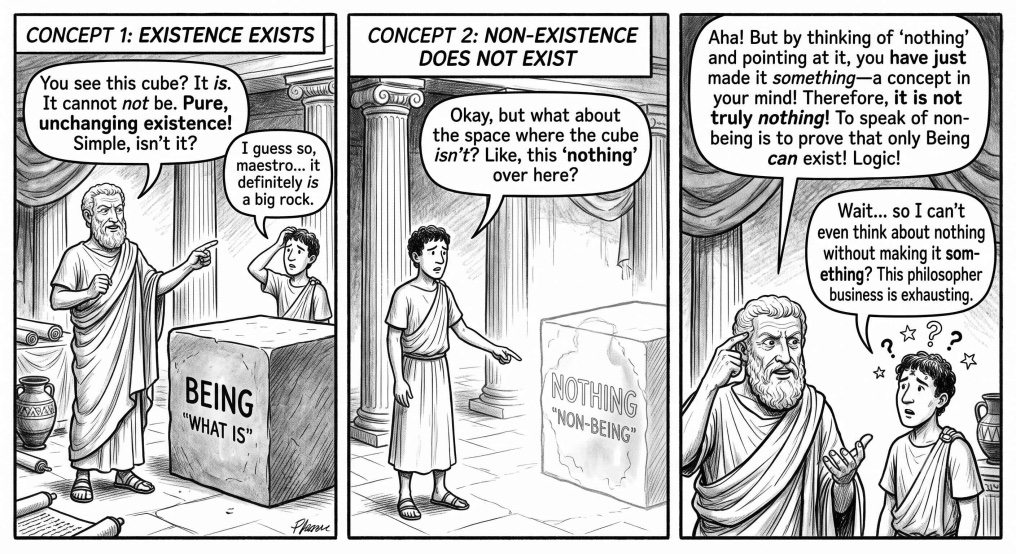
Some philosophers argue that existence is necessary, and that non-existence or nothingness is inherently impossible or contradictory, as suggested by Parmenides. According to this view, there must be something because the alternative, non-existence, is logically incoherent.
Parmenides held the view that “what-is” (being) exists and “what-is-not” (non-being) does not exist.
This idea is often interpreted as a rejection of the possibility of nothingness or non-existence, as Parmenides argued that non-being is simply not a part of reality. Parmenides argued that non-being is simply the absence of being and does not have any positive properties or characteristics.
It’s clear that if it is not possible to imagine a state of affairs in which there is truly nothing, it logically would mean that there is should be something (non-nothing).
Nothing (absolute non-being) is a self-contradictory idea of mind.
Its not possible to manifest true absolute nothing in reality due to its self-contradictory nature because non-existence could not have any attributes, including its own existence so it contradicts itself in general Given this assumption, it may be difficult to conceive of a state of absolute non-being, since such a state would not have any properties or qualities, including the property of existence itself. As a result, it is argued that the very idea of nothingness is fundamentally self-contradictory and that it is logically necessary that there must be something (i.e., non-nothing) rather than nothing.
This view that has been expressed by a number of philosophers throughout history. Some notable examples include: Parmenides: As I mentioned earlier, Parmenides argued that “what-is-not” does not exist and that non-being is simply the absence of being.
Aristotle: Aristotle, in his Metaphysics, argued that nothingness is a privation or lack of being, and that it cannot be considered a positive entity or a state of affairs.
Gottfried Wilhelm Leibniz: Leibniz, in his Monadology, argued that the existence of the universe can be explained by the existence of a necessary being or God, and that the idea of nothingness is inherently contradictory and cannot be conceived of as a positive concept.